
Why do these voices matter?
My most popular guests and their thoughts about the future and the present

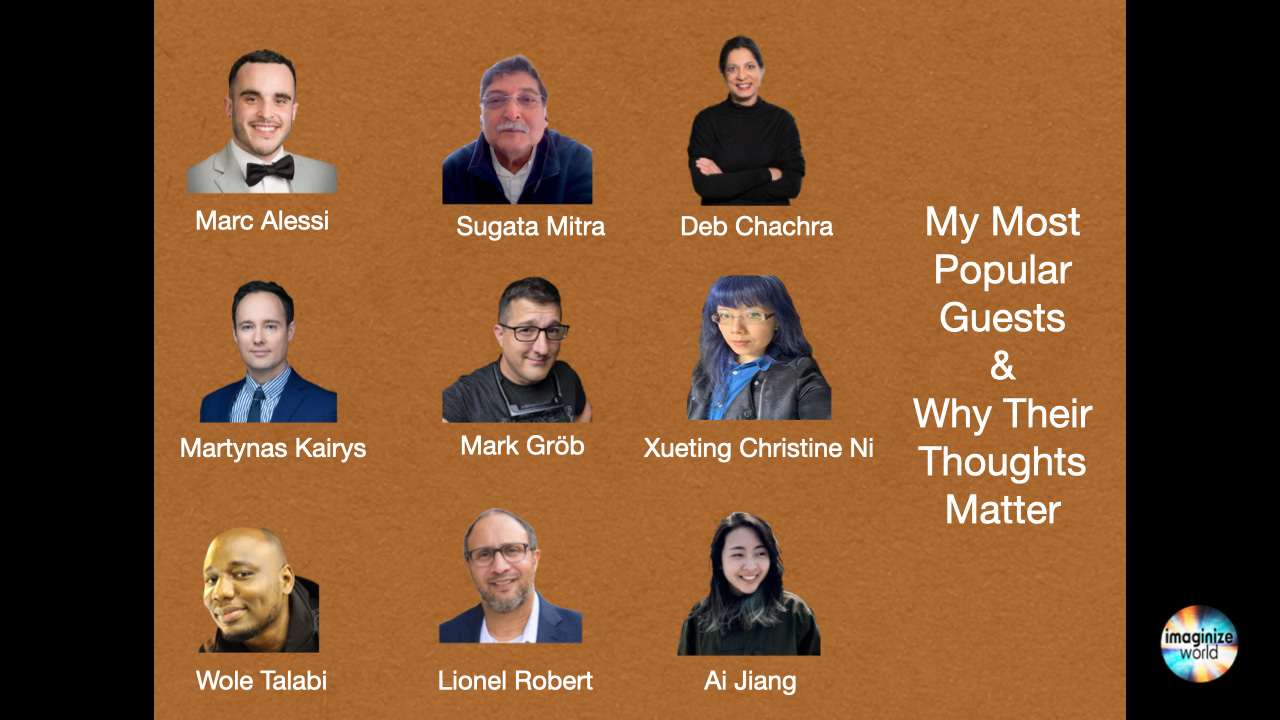
I singled out the most popular guests on Imaginize.World. Since their ideas had clearly moved their audiences, I looked again at their messages to see what themes stood out across this cohort:
A global perspective instead of focusing on their own near environment
Interest in working outside the system: self-organized learning vs. traditional schools, vibe coding vs. traditional software development
Reversal of widely accepted positive cultures with a somewhat negative impact: productivity, automation
Warnings about dangers that can happen if we are not careful, expressed in positive and helpful tones
Click on “Person” to see the guest’s page on Imaginize.World with links to videos, podcast, full transcripts, associated information. Click on the title links to go straight to the most popular short videos. If relevant, there is also a link to the Wikipedia page about them.
Here we go!
Marc Alessi is Director and Professor of Information and Robotics at the University of Michigan and a climate science fellow at the Union of Concerned Scientists. To bridge the gap between scientific research and policy-making, Marc emphasizes the importance of interdisciplinary partnerships between climate scientists and lawyers to advance climate litigation strategies. Person. Fighting an Anti-Science Administration.
Sugata Mitra is an Indian educational theorist, computer scientist, and innovator renowned for challenging traditional education models. He created the famous “Hole in the Wall” experiment, which showed how students can learn without traditional teachers. His one-million-dollar TED prize in 2013 was given for his bold ideas and a vision for making global change. Person. Sugata Mitra Explains the Hole in the Wall Experiment How Kids Learn on Their Own and https://en.wikipedia.org/wiki/Sugata_Mitra
Deb Chachra is a Canadian-American professor of engineering at Olin College, working at the intersection of technology and culture. Her 2023 book How Infrastructure Works: Inside the Systems That Shape Our World was recognized by Publishers Weekly as a ‘Best Book of 2023’. She creates student-centered learning experiences with hands-on courses that help young technologists think in new ways about the world. Person The Ozone Hole. We Fixed it and Why It Matters Today and https://en.wikipedia.org/wiki/Deb_Chachra
Martynas Kairys , based in Lithuania, is Director of AI Strategy and Development at Shift4, a company redefining commerce by simplifying payments ecosystems across the world. He leads the AI initiatives in strategic planning, team leadership, and hands-on development work. He strongly believes in the importance of critical thinking and adaptability, especially for the younger generation. Person Vibe coding 101: Why it Matters
Mark Gröb applies advanced technologies for UPS—including AI, automation, and immersive platforms—to transform global operations. His initiatives translate emerging technologies into measurable business outcomes across workforce transformation, safety, and operational efficiency for daily operations. Person What They Want You To Believe
Xueting Christine Ni is a writer and curator of contemporary Chinese culture and science fiction, working to bring light to modern China from historical and contemporary angles. Her anthology Sinopticon shows the diversity and depth of the Chinese science fiction tradition, and how science fiction explores social and political issues. Her unique cultural background bridges Eastern and Western perspectives. Person Why Doomism Is the Real Threat to the Future
Wole Talabi is an engineer-writer. On the engineering side, Wole is a senior reservoir engineer with 10 years of experience, from field management to digital oilfield and field development planning. On the writing side, I talked with him when he was based in Nigeria about his science fiction focused on African futurism that blends African culture with convergence challenges Person Why We Need a Ministry of the Internet and https://en.wikipedia.org/wiki/Wole_Talabi
Lionel Robert is a professor of information and robotics at the University of Michigan and a director of their autonomous vehicle research collaboration, MAVRIC. He has researched different dimensions of technology and humans. His research includes the emotional relationships between people and robots. Person Robotics: Shaping Inequality in Global Labor
Ai Jiang is a Chinese-Canadian writer, a Nebula Award finalist, and an immigrant from Fujian. She explores themes of societal influence, cultural assimilation, and the intersection of technology and humanity. She deals with the complexities of language, cultural identity, and the impact of historical injustices. Person The Burnout Economy: When Time becomes Cheap and https://en.wikipedia.org/wiki/Ai_Jiang
I'd love to know what you think about the messages from the people above. If you've checked out their person pages on Imaginize.World or the short video links, please share your thoughts with us.
It's an impressive lineup Jane. Congratulations for using your diligent curiosity about our emerging and imaginable futures to discover and highlight their voices and ideas !